
One sunny day during the doctoral program, I was sitting at my desk writing the thesis, classical music playing in the background, the sky was blue, the air was calm when suddenly my tea-cup started shaking. My keyboard was moving and for a second I thought it might have been a nervous tick from my fingers. Am I trembling? Then suddenly everything shook down to my big toe. I froze. I didn’t know what was happening and at the time I was living in a high rise and my next thought was how in the world am I going to walk down so many flights of stairs? Do I take the stairs or the elevator? All I could do was text my friend from class who instead of helping me calm down was also freaking out not knowing what was happening. Meanwhile, little did either of us know that there was an earthquake happening before our eyes plus three aftershocks. Oh, my goodness, I need to save my laptop and thesis!! That’s what I thought of instead of dropping to the floor.

Drop, Cover, and Hold On. These were the key words I learned during my participation in the 2025 International ShakeOut Day Great Northeast region’s earthquake drill. The event provided the opportunity to learn both practical skills and awareness on earthquake safety. During the drill, I got down on my hands and knees and took cover under the table to stay protected from falling objects. According to official U.S. experts, “people do survive under furniture or other shelter,” and recommend Drop, Cover, and Hold On, as an appropriate action to reduce injury during earthquakes over standing in a doorway or running outside (Earthquake Country Alliance, 2025).
As of October 18, 2025, there were over 58.5 million global participants and more than 19.5 million in the U.S. For the Great Northeast region in 2025, the event had 146,648 registered individuals, a decrease of about 2.42 percent from 2024, which recorded 150,282 participants according to data from ShakeOut.org. Nine U.S. states had registered for this event (Connecticut, Massachusetts, Maine, New Hampshire, New Jersey, New York, Pennsylvania, Rhode Island, and Vermont). The top three states with the most participants were Pennsylvania (83,208), Massachusetts (34,427), and New York (10,920).
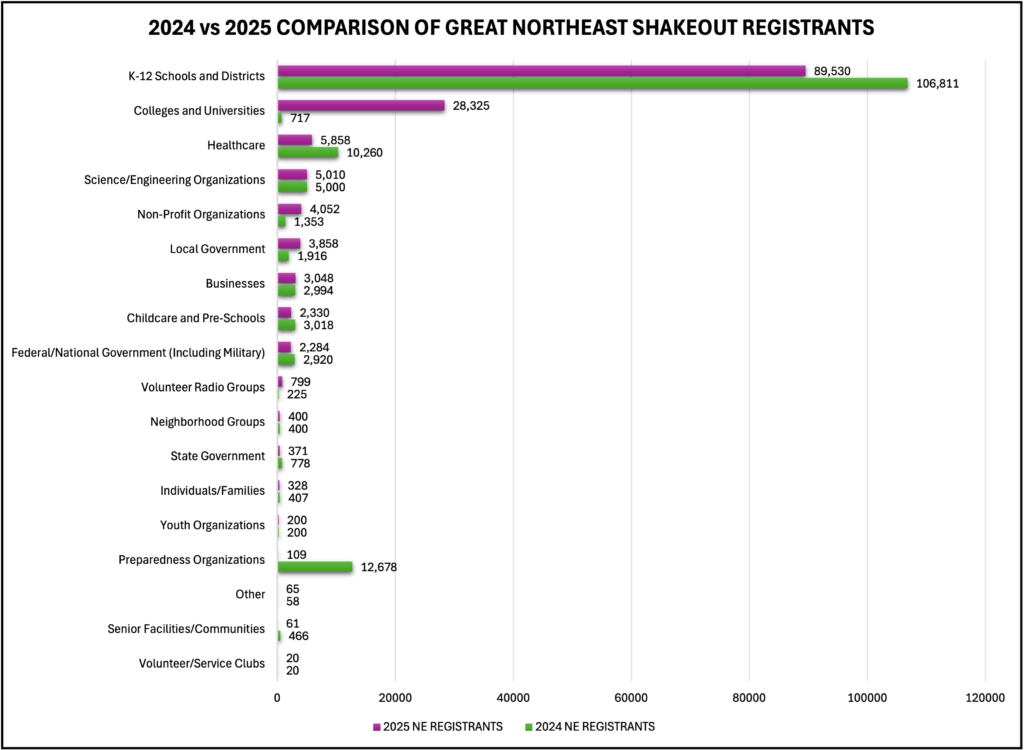
Figure 1 provides a comparison chart between 2024 and 2025 registrants by category. The top five categories that show a consistent registration for both years were K-12 schools and districts, colleges and universities, healthcare, science/engineering organizations, and non-profits. The data shows an increase in registration for the colleges and universities category from 717 in 2024 to 28,325 in 2025. The event saw an astounding 3,850 percent increase in participants in this category from 2024 to 2025. Another category that resulted with a large skewness is the preparedness organizations category with 12,678 in 2024 to 109 in 2025. Participation from preparedness organizations came down by approximately 99 percent compared to 2024. This significant decline could reflect a change in how participants categorized their organizations rather than an actual drop in engagement.
Figure 1. ShakeOut Participation Growth from 2024 to 2025
Source: Data from ShakeOut.org, chart created by author (2025).
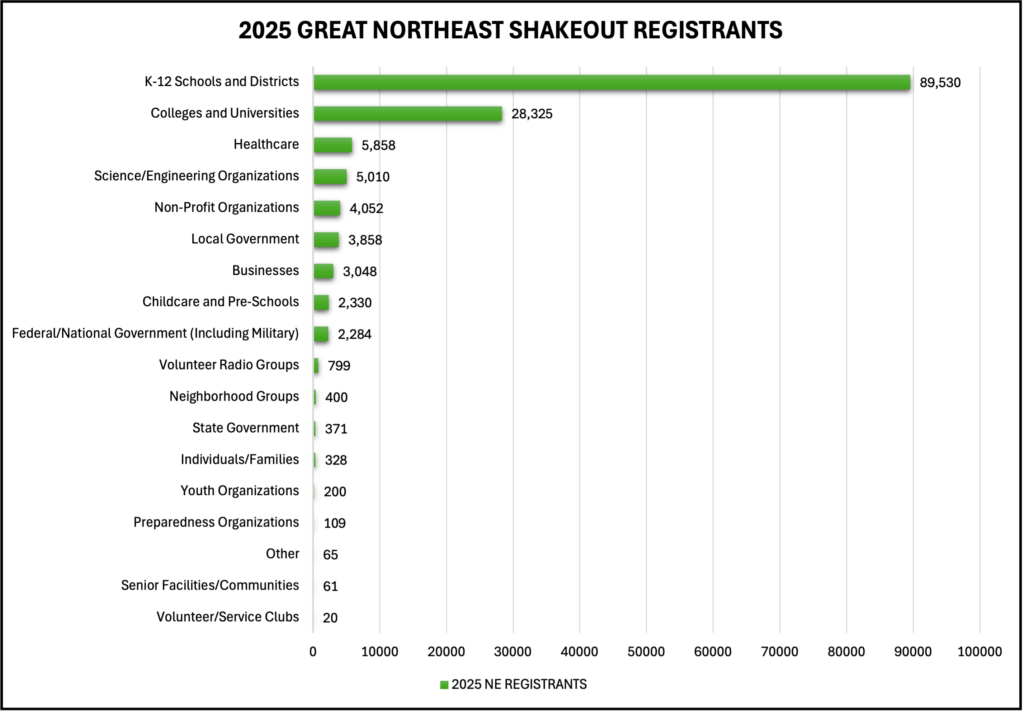
In the Great Northeast region, Figure 2, showcases the different categories that registered for the event. According to ShakeOut.org stats, the top five categories to register for the event includes, K-12 schools and districts (89,530), colleges and universities (28,325), healthcare (5,858), science/engineering organizations (5,010), and non-profits (4,052).
Figure 2. 2025 Great Northeast ShakeOut Registrants by Category
Source: Data from ShakeOut.org, chart created by author (2025).
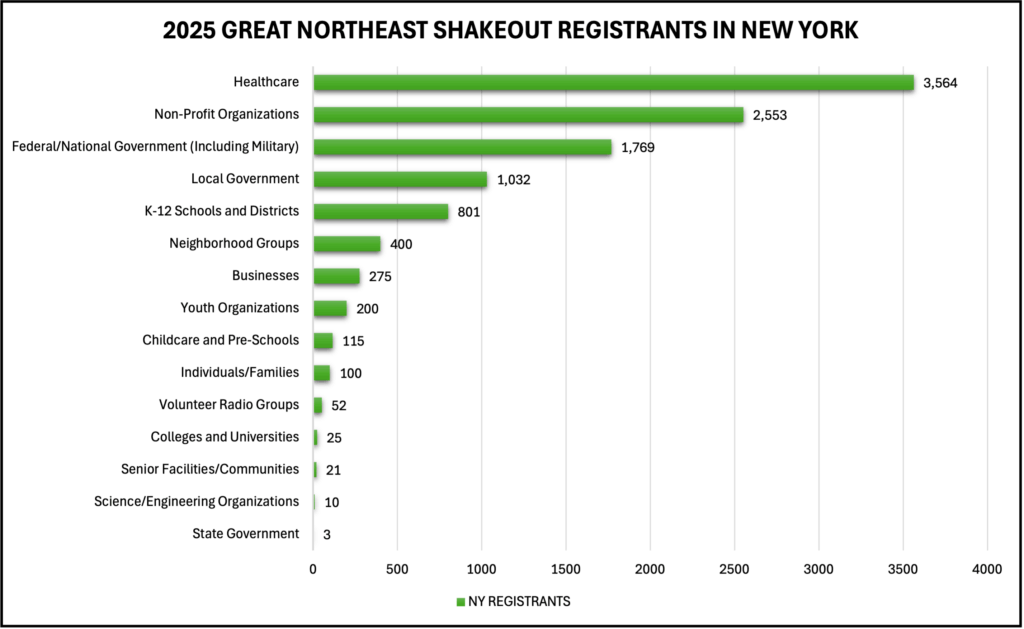
Particularly in New York, Figure 3 illustrates the top five registered categories stemming from the healthcare (3,564), non-profit organizations (2,553), federal government (1,769) industries respectively, local government (1,032), and K-12 schools and districts (801).
Figure 3. 2025 ShakeOut Registrations in New York
Source: Data from ShakeOut.org, chart created by author (2025).
Collectively, these charts highlight the growing awareness and interest among individuals and organizations in learning how to protect themselves. Participating in events like the Great ShakeOut helps people build the skills and confidence needed to stay safe during real emergencies.
Below are the seven steps to earthquake safety with general action plans to help you and your families prepare for unexpected earthquakes.
7 STEPS TO EARTHQUAKE SAFETY
- Secure Your Space
Earthquakes can move almost any objects, large or small. Envision your home as a snow globe that you can shake. Which items can be thrown around? Which object can cause you harm?
Action Plans:
- Move furniture such as shelves or bookcases away from places people sleep, sit, or spend a greater amount of time.
- Move heavier objects from higher shelves to lower.
- Secure televisions, bookcases, computers, etc.
- Hang mirrors and frames on secure hooks.
- Plan to be Safe
Create an emergency plan including how you will communicate with friends and family. Even if you speak with them for five minutes to brainstorm, five minutes can save your lives. Not only will planning help for this emergency, but it will also serve for other potential disasters.
Action Plans:
- Map out what to do before, during, and after an earthquake with family and friends.
- Think about pets and plan on how to handle a situation when you are in one room, but your pet happens to be in another. How will you get to them? Once you have your pet, how will you handle them?
- Paste the action plan on a place where your family will see, such as the refrigerator.
- Exchange contact numbers with each other and choose a place where you will meet. In case you get separated, you’ll know how to find one another.
- Organize Emergency Supplies
Store emergency supplies in places where you have easy access, including home, work, and cars.
Action Plans:
- In case the earthquake happens while you are sleeping, have a bag handy for your shoes, flashlight, batteries, medication, etc.
- Create a car kit with three (3) day of supplies for sudden evacuations.
- Home/Work. Have a go-bag that includes all your supplies for up to 2 weeks in case you have to shelter in place.
- Minimize Financial Hardship
Minimize financial hardship by organizing paperwork to avoid headaches in the aftermath. Earthquakes shake out lives and potentially our pockets if we don’t take preventive actions of our finances.
Action Plans:
- Stabilize your home by improving the structure to reduce the cost of damages. The same applies to apartments by scanning everything and securing items you think might cause damages that will cost you more in the end.
- Consider earthquake insurance to cover the cost of huge damages.
- Organize important documents in case you need to leave your place fast.
- Think about which documents you need and make copies.
- Drop, Cover, and Hold On
Many emotions come into play during an earthquake and sometimes our immediate reaction is to stand in a doorway or do nothing. Back and forth motions cause the ground to jerk and unsecured objects to fall or fly around you. According to Federal, State, and local emergency management experts, the following actions reduce injury.
Action Plans:
- Drop to your hands and knees reduces the chances of falling debris or flying objects.
- Cover your head and neck with one arm and hand.
- Hold On to the shelter (i.e. the table or table legs) with one hand and ready to move in case the table shifts.
- Improve Safety
As soon as the floor stops shaking, it’s time to take quick action to improve your safety and the safety of your loved ones.
Action Plan:
- Go to higher ground in case of a tsunami.
- Check for any injuries that need immediate attention.
- Assist those in need.
- Scan your area for any new dangers like electrical or leaking gas lines.
- Remember your emergency plan.
- Be prepared for any aftershocks that can cause additional damages.
- Reconnect and Restore
After a disaster event, it’s good to reconnect with family, friends, and neighbors. The process of recovery can be faster with the aid of others. Once you have taken care of yourself and immediate needs, communication is key to recovering.
Action Plan:
- Turn on TV, radio, or digital media for important safety advisories.
- Contact your insurance agent if your home is damaged and start the claims process.
- Look for any presidential disaster declarations and resources from your federal, state, and local government.
Preparedness starts with awareness, and awareness grows through action. Take a few minutes today to reflect, prepare, and practice these steps with those around you.
For further information on preparedness and the seven steps to earthquake safety, please visit the site at Earthquake Country Alliance.
REFERENCES
Earthquake Country. 2025. Seven Steps to Earthquake Safety. Accessed October 18, 2025. https://www.earthquakecountry.org/sevensteps/
Earthquake Country. 2025. “Why Rescuers and Experts Recommend Drop, Cover, and Hold On.” Accessed October 18, 2025. https://www.earthquakecountry.org/dropcoverholdon/
ShakeOut. 2025. “Great Northeast ShakeOut Participants.” ShakeOut Stats. Accessed October 18, 2025. https://www.shakeout.org/northeast/participants.php?start=All